FACILITATOR GUIDES: The Complete Resource for Building Better Instructor-Led Training
Facilitator guides are the backbone of effective instructor-led training, providing the structure, clarity, and confidence facilitators need to deliver consistent, engaging learning experiences. This comprehensive resource brings everything together in one place, from understanding what a facilitator guide is and breaking down its core components to step-by-step guidance on how to build one.
You will also find proven best practices and answers to common questions that help you avoid pitfalls and elevate your design. Whether you are creating your first guide or refining your current approach, this page is designed to help you build facilitator guides that truly support both instructors and learners.
The success of instructor-led training (ILT) hinges on the quality of its delivery. You can have well-designed content, strong learning objectives, and great activities, however if facilitators struggle to deliver the session consistently, the training breaks down.
That’s where the Facilitator Guide comes in.
A facilitator guide is the backbone of effective instructor-led training (ILT). It’s the document that turns training design into confident, repeatable delivery; ensuring learners get the same high-quality experience every time, no matter who is facilitating.
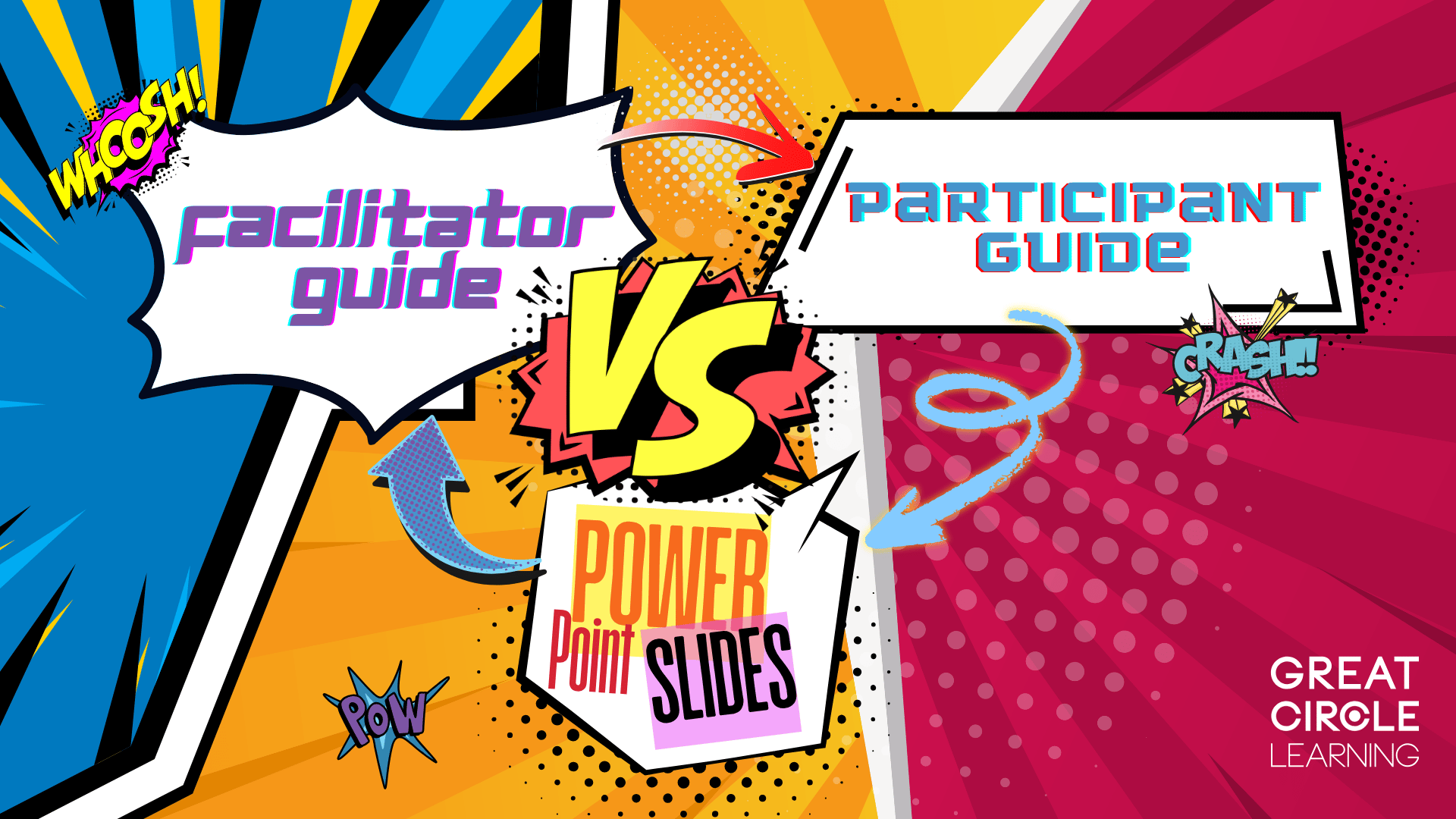
Facilitator Guide vs Participant Guide vs PowerPoint
If you have ever heard someone say “The slides are the training,” you are not alone. In many organizations, facilitator guides, participant guides, and PowerPoint notes all get lumped together as interchangeable training materials. They are not.
Each of these tools serves a very different purpose. Confusing them leads to inconsistent delivery, frustrated facilitators, disengaged participants, and training that works only when the perfect presenter is in the room.
Let’s break down what each one actually does, what it does not do, and why you need all three to create effective instructor-led training.
Most organizations are pretty good at creating training. The real struggle is delivering it consistently.
You can have solid content, good slides, and clear objectives and still end up with very different experiences depending on who is facilitating, how much time they had to prepare, and whether they have run the session before. That inconsistency usually gets blamed on facilitators. In reality, it is almost always a delivery support problem.
A strong facilitator guide is one of the simplest ways to improve instructor-led training. Not because it makes training more exciting, but because it makes it easier to repeat, easier to scale, and more likely to work.
Great training requires more than just PowerPoint Slides.
Step into any modern training session, and you’ll likely observe a PowerPoint slide deck projected on a screen, serving as a visual anchor for the content presented. For many, these slides are synonymous with training itself—a tool for pacing, presenting information, and keeping the session on track. Yet, as any seasoned trainer will tell you, a slide deck alone is a blunt instrument. To truly foster learning, engagement, and adaptability, there’s an often-unsung hero at work behind the scenes: the facilitator guide.
What distinguishes a facilitator guide from the beloved PowerPoint, and why is it so crucial to the art of effective training?
Let’s explore the essential contributions a facilitator guide makes to the world of learning experiences, and why relying solely on slides falls short.
Learn About:
Why slides are useful, but limited
What exactly is a facilitator guide
The differences between slides and a facilitator guide
A well-designed facilitator guide does more than outline content. It acts as a structured roadmap that helps facilitators deliver consistent, engaging, and effective learning experiences. In this section, we break down the anatomy of a facilitator guide so you can clearly see what makes it work and why each element matters.
By understanding how the pieces fit together, you can create guides that not only support the facilitator in the moment but also reinforce strong learning outcomes for participants.
We will explore the key components every facilitator guide should include, gain insight into the different roles a guide plays before, during, and after delivery, and learn practical approaches for tracking time so sessions stay on pace. These elements work together to reduce facilitator guesswork and improve overall training quality.
Key Components of a Facilitator Guide
Instructor-led training isn’t going anywhere.
But the expectations around how it’s designed and delivered have changed. Today’s training teams are under pressure to move faster, deliver consistently, and scale programs across facilitators, locations, and formats. That’s almost impossible without one critical asset:
A well-constructed facilitator guide.
At Great Circle Learning, we often say the facilitator guide is the ruling document of your training program. It’s what turns your learning design into a repeatable, high-quality experience, no matter who is delivering the session.
Learn About:
The 3 main sections of a facilitator guide
All the component pieces that build those sections
A well-designed facilitator guide does more than organize content. It supports instructors before the session begins and enables them to deliver a consistent, engaging experience in the moment.
Think of it this way: a facilitator guide serves two essential roles throughout the instructional lifecycle. First, it acts as a preparation and study tool. Then, it becomes a real-time delivery aid.
When both roles are fully supported, facilitators are more confident, sessions run more smoothly, and learners have a better experience.