

The success of instructor-led training (ILT) hinges on the quality of its delivery. You can have well-designed content, strong learning objectives, and great activities, however if facilitators struggle to deliver the session consistently, the training breaks down.
That’s where the Facilitator Guide comes in.
A facilitator guide is the backbone of effective instructor-led training (ILT). It’s the document that turns training design into confident, repeatable delivery; ensuring learners get the same high-quality experience every time, no matter who is facilitating.
A Clear Definition
A Facilitator Guide is a behind-the-scenes instructional document that tells the facilitator:
-
What to do
-
When to do it
-
How to do it
-
Why it matters
-
How to prepare beforehand
It supports the preparation and delivery of training, not the consumption of content. While participants see slides, activities, and exercises, the facilitator guide provides instructions, timing, prompts, and guidance that help the facilitator focus on teaching instead of improvising.
In short:
Participants learn from the training while facilitators lead the training session from the facilitator guide.
Who Needs a Facilitator Guide
Facilitator guides support a wide range of roles, including:
-
Professional trainers
-
Subject-matter experts delivering training
-
Internal staff facilitating workshops
-
New facilitators onboarding into existing programs
-
Train-the-trainer roles
-
You
Any time training is delivered in a classroom environment, not just self-paced content, a facilitator guide plays a critical role.
What a Facilitator Guide Is Not
Facilitator guides are often misunderstood. They are:-
Not participant workbooks
-
Not slide decks with speaker notes
-
Not just an agenda or outline
-
Not a script to read word for word
A well-built facilitator guide does not replace facilitation skills, but it supports and enhances them.
What a Facilitator Guide Should Include
While formatting may vary, effective facilitator guides should include:
-
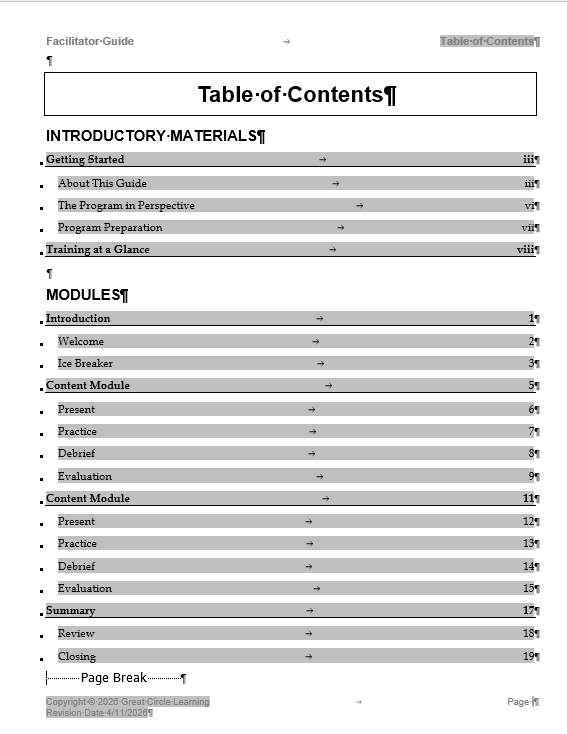
Table of Contents

The Table of Contents should be the visual representation of your course's structure. At a minimum, your course structure should be a two-level hierarchical system tied to your terminal and enabling objectives. The table of contents should be usable by participants to easily refer back to key items after the course.
-
Instructor Preparation Section
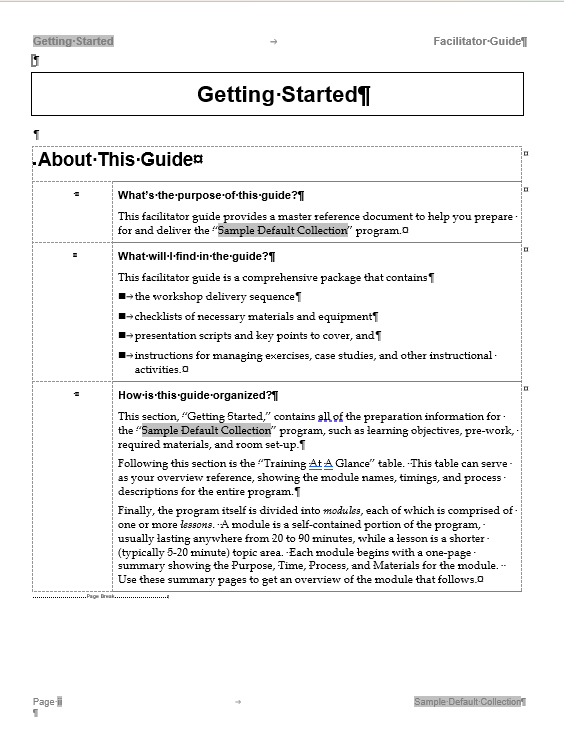
Think of the instructor prep section as a study guide to ensure whoever is leading the session is prepared.

The About this Guide section is the one insurance policy if your everyday facilitator is out. It explains how the guidebook is structured and how to use it effectively.

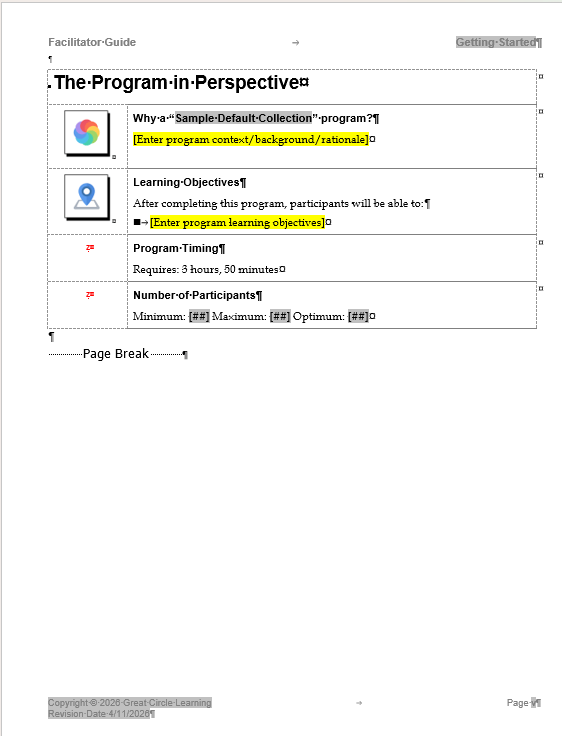
The Program in Perspective provides the facilitator with an overview of the "What" and the "Why" of the training, along with the overall timing and attendance requirements.

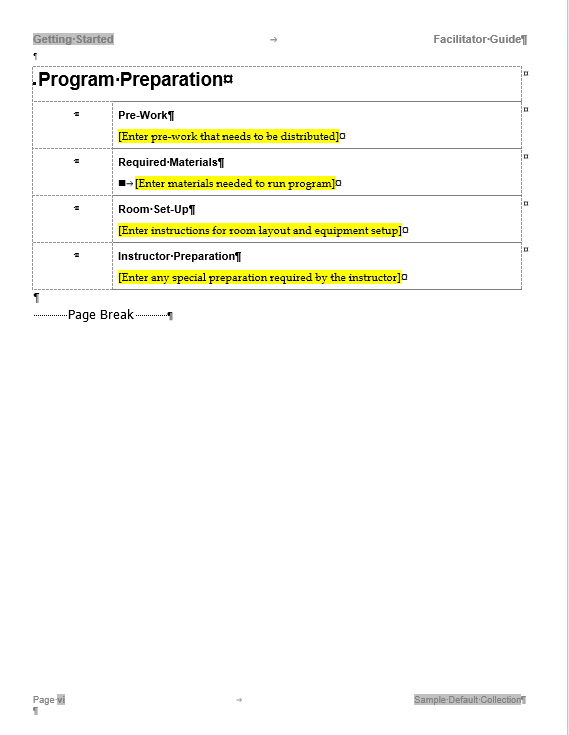
The Program Preparation section outlines everything needed to run the training successfully, from prerequisites and materials to room setup, and clarifies what facilitators must complete before the session begins.
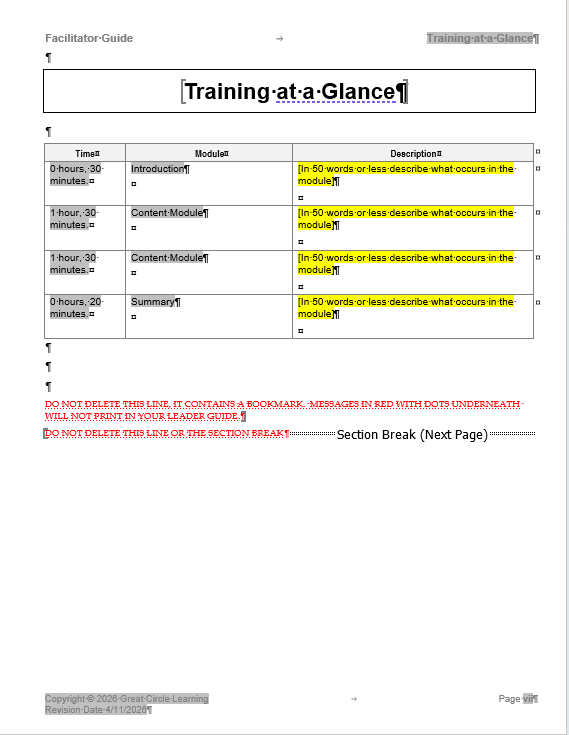
The Training at a Glance provides a high-level scope of what is happening in the training at the module (terminal objective) level. It provides timing and a general description of what happens in each module.
-
The Delivery Section
This is the section most people think of when it comes to facilitator guides. It has the Say This, the Do This, and the Show This Slide. But a truly well-crafted guide is so much more than that.

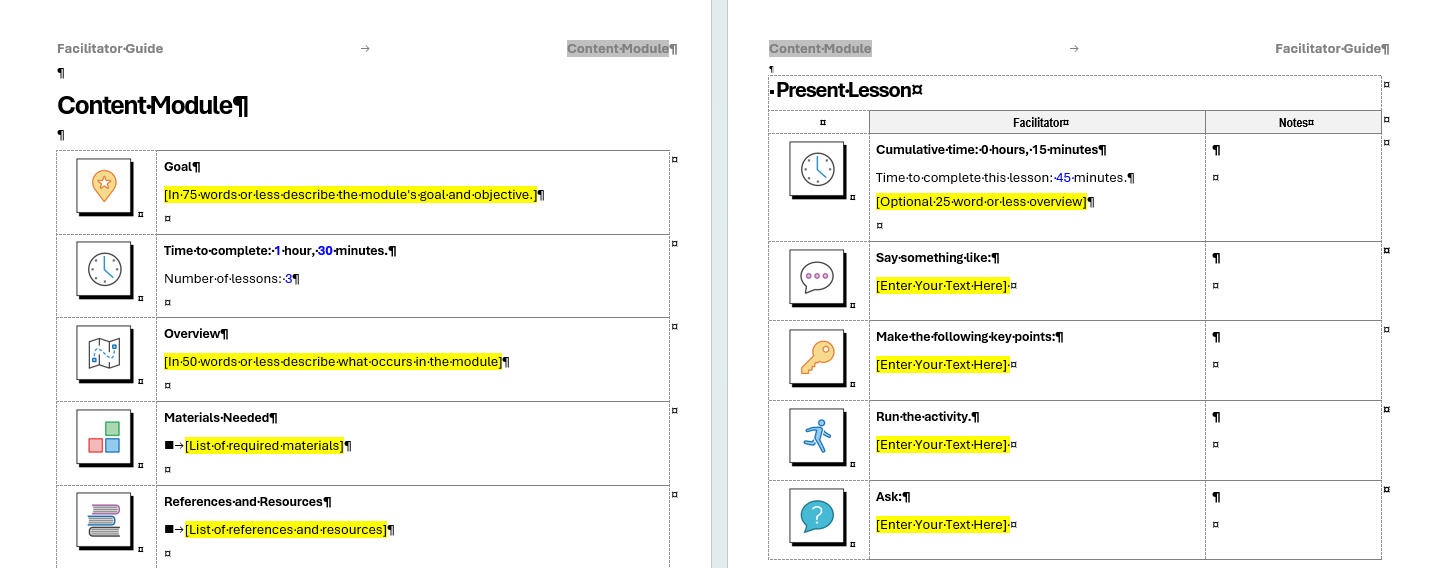
There should be a Module Overview page for each module (terminal objective) in the training program. It will capture:
-
Module Goal
-
Timing
-
Module Overview
-
Materials Needed
-
Resources & References
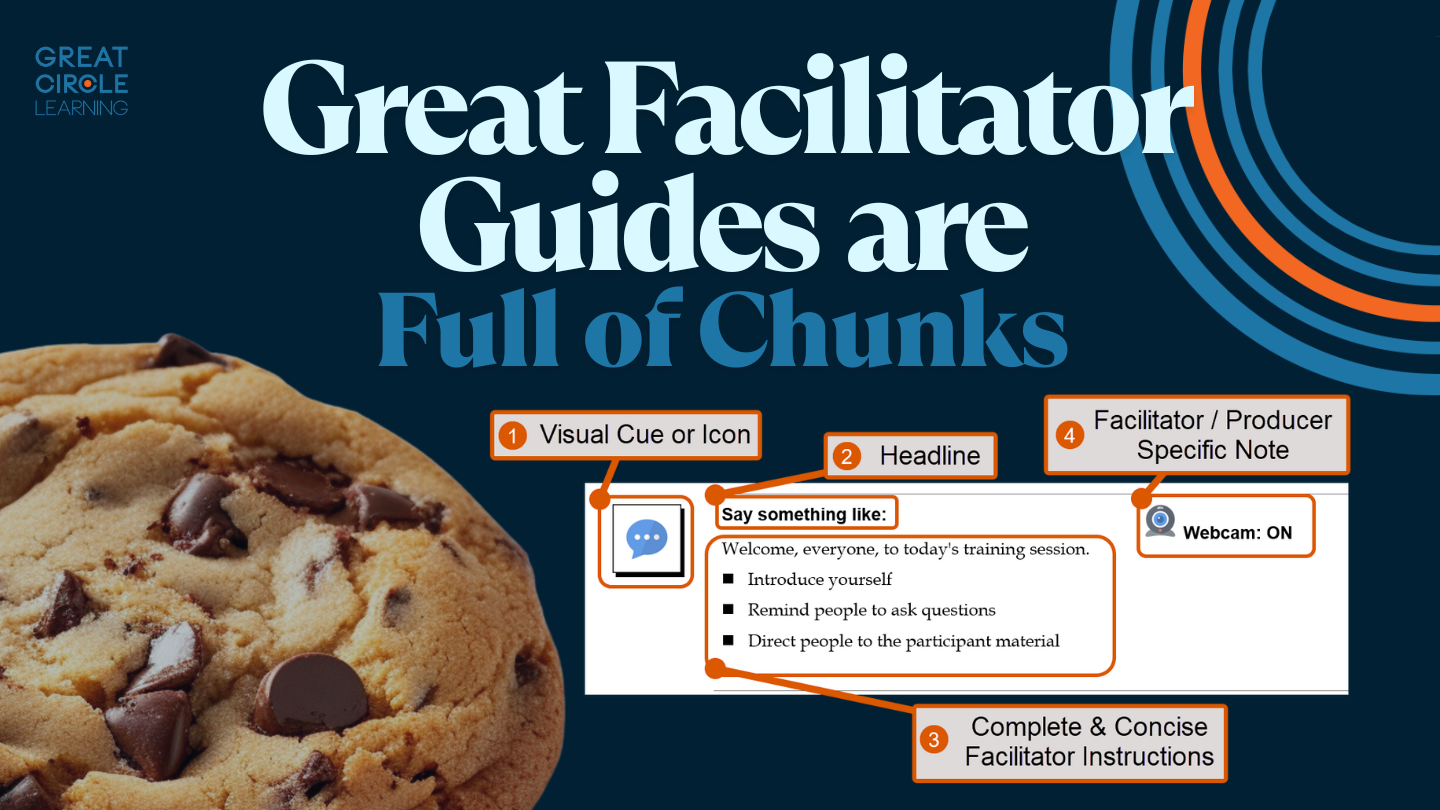
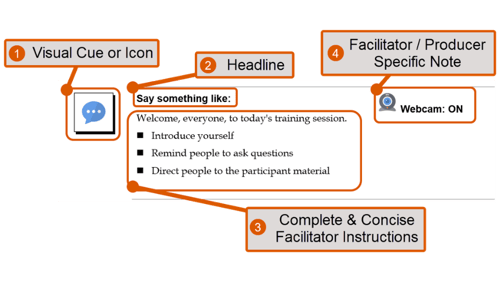
The Content Block provides information at a glance to the facilitator so they can keep their eyes on the class or the camera. A Content Block is made up of:
-
Visual Cue
-
Headline
-
Complete & Conscise Facilitator Instructions
-
Facilitator and/or Producer Specific Instructions (when needed)
-
The best facilitator guides are written for real-time use: scannable, structured, and easy to follow while facilitating.
Facilitator Guide vs. Participant Guide
One of the biggest mistakes in training design is blending these two documents.
Facilitator Guide
-
Focuses on preparation & delivery of content
-
Includes instructions, timing, and intent
-
Written for the person leading the session
Participant Guide
-
Focuses on learning and post-course review
-
Includes content, exercises, and space for notes
-
Written for the learner
Keeping these separate improves clarity, reduces clutter, and makes both documents easier to use and easier to update.
Why Facilitator Guides Matter
Facilitator guides aren’t “extra documentation.” They directly impact training outcomes.
They help organizations:
-
Deliver training consistently across facilitators and locations
-
Reduce prep time and facilitator stress
-
Ramp up new facilitators faster
-
Preserve institutional knowledge
-
Scale instructor-led programs without quality loss
Most importantly, facilitator guides let facilitators focus on what matters most: engaging learners and supporting learning transfer.
Common Mistakes to Avoid
Many facilitator guides fail not because they exist, but because they aren’t usable.
Common pitfalls include:
-
Overly scripted text that kills natural facilitation
-
Vague instructions like “Run activity” with no guidance
-
Copying slide content into the guide instead of adding value
-
Poor formatting that’s hard to scan during delivery
-
Treating the guide as an afterthought instead of a core deliverable
If facilitators don’t rely on the guide during delivery, it signals that the guide needs improvement.
What Makes a Great Facilitator Guide
Effective facilitator guides share a few key traits:
-
Clear structure and visual hierarchy
-
Action-based language (“Do,” “Ask,” “Explain”)
-
Separation of content, instructions, and tips
-
Designed for both new and experienced facilitators
-
Built to be used live. Not just read once
A facilitator guide should feel more like a roadmap than a script.
When You Should Create a Facilitator Guide
If your training is:
-
Instructor-led (in-person or virtual)
-
Delivered by one or more facilitators
-
Reused or scaled across teams
-
High-risk, compliance-based, or business-critical
-
Dependent on the consistency of delivery (it always does)
…you NEED a facilitator guide.
Final Takeaway
A facilitator guide is the operating system for instructor-led training. It connects design to delivery, supports facilitators, and ensures learners get a consistent, effective experience.
If your organization invests in training, but not in facilitator guides, you’re leaving results to chance and taking on huge risks.
Build better facilitator guides, and the quality of your training improves by default.